I recently started going through my father’s things. I had received them a few weeks back in the post, but these things take time. While going through his military memorabilia, I found a repurposed photo album. It contained, for the most part, my poetry written when I was an adolescent.
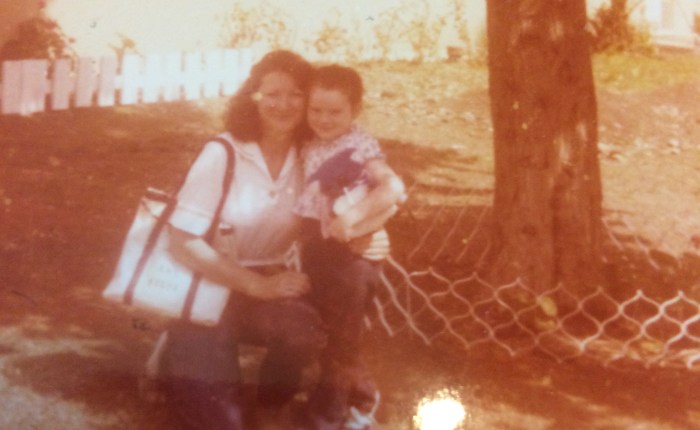
The first page is a list of quotes from authors and thinkers. And, taped to the inside cover is a picture. It is faded slightly and has a reddish tint. It is a picture of me and my mum. We are standing outside a house next to a tree. Mum is kneeling down on one knee; I am standing – I am about four years old, I would guess. Our faces are touching as we look to the camera smiling. I am clutching a blue Koala Bear. It is not one I remember. It is a sweet picture, and it makes me smile. Though, it also makes me reel a little, just a touch.
All the parts of our lives that we do not remember, but our mother does. Fundamental times of development – keys to our personalities, and only snippets linger for us. Many of our “firsts” experienced by the other – mother, father, guardians of us. I have only their word that my first word was chocolate. Though, in fairness, this does seem accurate to me.
What was I thinking when I held onto a chair, table, someone’s leg or hand, and reached tentatively toward another desired spot? Tottering along mostly through momentum than design. Was I thrilled by the lack of fall as my foot planted and held me up? I bet, at the very least, my mum knew how I felt. She almost always does to this day.
I am not sure when I started to hide these feelings, though mostly failing to do so. Sometimes hidden to keep from getting into trouble, and other times to keep from seeing that worried look that said, “tell me.” Maybe this is where the whole fruit in the Garden story stems from. The innocence of lost first steps to the shame of knowing all too well.
I see this struggle happening in our students. They struggle with the notion of telling. Whether about others or themselves. It manifests in many different ways. Some tell too much – giving everything of themselves to anyone who will listen; other won’t speak o word of truth; others still won’t speak a word. All of this I see as a form of preservation and protection. It is easy to see in the ones who guard closely what they have to say about themselves. Yet, it is also true of the chatterboxes. They lay everything bare, exposed so that people won’t wound them with secret stories. They can brush off the rumor mill with “oh yeah, I told everyone about that ages ago.” And, it is true of the ones who cannot tell a true thing about themselves – always searching for that one story that will elicit approval and connection.
Behind it all are the forgotten memories of “firsts” – the first look of disapproval, the first time being laughed at, the first rejection or withdrawal of love. Chances are their mothers remember, and somewhere deep inside – so do we.
As a teacher and now a principal, it is necessary to seek out their selves as a way of connecting, to reaching the truth of them, to keeping them safe. And, sometimes, I cannot keep what I find to myself. I cannot pretend I did not see or hear what they have shown me. And when this happens, and it does, I run the risk of losing that connection between us.
I could say it’s because it is “my job,” but it is so much more than that. It is my responsibility, my calling, my mission, along with all of my colleagues. This is not to say it does not hurt to see them pull away, to accuse you of betrayal, of not listening – but, you live with that because loco parentis is our duty. Not “in place of the friend” – “in place of the parent.” My colleagues and I serve as our students guardians.
So, today’s form is an ode. An English Ode. The English Ode is ten lines per stanza, with as many stanzas as the poet wishes; iambic meter; rhyme scheme: ababcdecde.
An Ode to Mothers from a Childless Mother
I.
Mothers are the keepers of our secrets,
the ones we attempt to hide from ourselves.
Ones only she knows and never forgets.
Ones whispered in our amniotic shells.
Does she smile sweetly and remember?
When her hand passes over her belly
do those whispers sing out to her again?
She’s the balance of love and protector.
And, if I may paraphrase Thackery
Mother is the name of God for children.
II.
Though of the age, I am not a mother.
Perhaps the passing of years will decide.
I know only the love for the other
for all those left with me to teach and guide.
Their children – they are ours for the meanwhile
from eight until four, five days of seven.
We stand in their stead loco parentis
We watch as they grow to adult from child.
They learn, embrace each critical lesson
until they’re ready to Be without us
BONUS!
In that repurposed photo album of my adolescent poetry, I found this gem. Just so I don’t get too ahead of myself, my 15-year-old self had some different ideas about school authorities…
On Duty
Good morning, what brings you up here?
Duty, got to watch those kids.
Chuckle, chuckle.
Talking amongst yourselves,
eyeing us suspiciously
checking all the bathrooms
like a walking smoke detector
itching to wail.
Hall patrol,
Lunch duty,
Bathroom check,
Pass clarifier…
When do you ever teach?
So there… Give either one a go! An ode or a protest poem!

 alltheformsblog