If poetry is where lost things find a home, then where do lost poems go?*

If poetry is where lost things find a home, then where do lost poems go?*

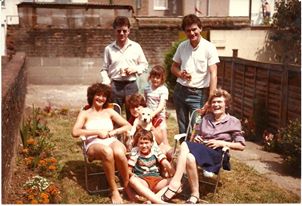
I wrote a poem. It was called, “The Smell of Cardboard J.” It had come out of a lesson my Sophomore English teacher, Ms. Bisbano had given. One that I now give to my students. For the first part, she showed us a series of images and we were to write down one sentence that came into our minds when we saw the image. Then we took those sentences and jumbled them around, cut them, played with them and created a poem out of them. That poem is in a folder at home. The next part, Ms. Bisbano handed out small pieces of cardboard, each of them labeled with a letter and each of them possessing a scent. Mine was labeled “J” and it smelled like Ponds cream and talcum powder. It smelled like my Gran, Kathleen Conway. She was, at the time, far away across the Atlantic Ocean in Ireland. My grandparents had, in fact, just moved back to Monivea from Gravesend, Kent in England to begin their retirement back home.

This smell that came from Cardboard “J” took me back to watching my Gran get ready for bed, and scooping out the Pond’s cream with three fingers, spreading it onto both hands in an effort to warm it up, then smoothing it over her face and neck. She would then take a folded tissue and begin wiping off the cream in long strips from the top of her forehead, down the side of her face, over her chin, and down her neck. Then the other side with a new, folded tissue. She would wipe her eyes next, right, then left. The last tissue would start in the corner of her eye, down the side of her nose and over her cheek, then the other. Her skin seemed clearer, glistening, soft. She has wrinkles in my memories, but I don’t think I ever really saw them at the time. After the had cleaned her face, she would take out her teeth and brush them in the sink, sometimes she would chuckle and say something to me to make me laugh. And our laughter produced more laughter, and her shoulders would move up and down with the rhythm of her joy. She always wore night dresses to bed – usually white with tiny flowers, pink and blue, and frills around the arms. And I would sit on the side of the tub and watch her at the sink, and it was wonderful. And with that smell, this poem came rushing out of me, and told the tale of Kathleen Conway – her strength, and joy, and faith, and heartbreak, and her love for me and mine for her, and it was perfect.

I had always liked writing since I was seven or eight, but here in my fourteenth year, with the production of “The Smell of Cardboard J,” I knew that I could write and would write. But now, the poem is gone. It is not in the folder with the image poem, it is not in any folder I possess. The poem is gone. All that remains in my mind is the name and memory. A few fragments of lines like “it smells of talc, and babies, and my grandmother….” and then it went on from there, I think.

And I do not know if it was as epic as I remember, but I believe it was. And maybe it is better that I can’t find it now, because what if it wasn’t? What if I read it today and thought, “Oh, I thought this was better.” No, I believe I would not think such things. But who knows. Can a poem really express the virtues and wonders of a person you have loved and still love even in their absence? I hope so. Perhaps the poem and my Gran are together. And she holds it close to her as though I had given her gold and not a page of torn out college ruled paper containing fifteen lines or so written with purple ink. So today, 40 year old me will attempt another poem for her. It may not be as good though. Who knows?

My hands remind me of her,
They are getting wrinkly now too.
There is a soft pouch
On the back of my hand
In between
and just below
My index and middle fingers.
She had these pouches too.
I remember pushing on them
They were soft,
And seemingly full of fluid.
As I pushed on one side
The other would rise,
I would trace her
protruding purple veins,
And smooth out her knuckles.
And she would let me.
And now, on my own hands,
I can do the same.
I got them from her.
And that is a comfort.


* A reference to Alice Walker’s Poem, “How Poems Are Made, A Discredited View.”
Haikus for My Fathers

Haikus for My Fathers

In less than a month, my Father will have been gone from this earth for six years. Three evenings ago, my second Father, my Step-Father, passed away.  I was not ready for either event.  The world is not the same. Again.

I.
Grief sits stoically,
solidly in the stomach
then it reaches up.

II.
Grief finds your heart next –
it knocks inside its chambers
echoing outward.

III.
Grief clenches your throat
removing air from your lungs
it continues up.

IV.
Grief reaches your face
escapes from your mouth and eyes,
leaving burning rain.

The Bop Form

My students don’t like change. It’s a little paradoxical at times, because with the same breath that they use to disparage the “we’re always doing the same stuff in here” they will say, “hey! We forgot to do the meditation at the beginning of class!” They do like routine, but they also want things new and exciting. It’s a conundrum. Though, perhaps I am being unfair. After all, aren’t we all like that?

In my Interpersonal Studies class, we learn about these mice. The mice are being tested by two different labs to examine how animals engage and explore new and somewhat scary circumstances. For the mice, it is a platform that eventually loses its walls and is just hanging above the ground with no protection. In one lab the mice are cautious, at first, but then bound up and down the new “maze” with little to no hesitation. But, in the other lab, the mice a skittish and do not venture too far from the safety of the walls if at all. At first, the scientists are stumped. These mice are from the same batch, they are fed at the same time, kept in the same laboratory conditions, etc. There is only one slight difference. In one lab, the lab assistant is allergic to mice. So they have gloves on, a mask, and handle the mice only when absolutely necessary. In the other lab, the mice are, to put it non-scientifically, much loved. They are petted and held in ungloved hands and handled for longer periods of time. Can you guess which mice were the more furtive?

What I find additionally interesting here, is that all the mice want to go down that unprotected platform, but the “untouched” mice just don’t have the courage. They don’t feel safe. Which again, seems to bring a paradox into existence – if I don’t feel safe, then I’m not going to try something dangerous. Maybe it’s the idea that you need an anchor to try something new. I will venture down this unprotected path because I trust that my protected path will be there when I get back.

We do all want new and exciting, but we also want that “secure base” that Goleman speaks of.[1] That familiar comforting place we can return to after the thrill of the new.
So it all comes down to building that base in my classroom. Which starts with building trust. Showing students that change is going to happen in life, but that doesn’t always have to be a bad thing. That they can try new things, and fail at new things, and that is just fine as long as they continue to try.

So, with that in mind, today I attempt The Bop Form. It is a relatively new form. It is, according to poets.org, a form of poetic argument. It is three stanzas long: 6 lines – 8 lines – 6 lines. The first stanza states the problem, and the second stanza explores or expands upon the problem. If there is a resolution to the problem, the third stanza finds it. If a substantive resolution cannot be made, then this final stanza documents the attempt and failure to succeed. I combined this form with another exercise I use with my students which is the personified abstract noun exercise. This has resulted in some breathtaking descriptions of such things as depression, anxiety, joy, and love from my students.[2] But I thought I would attempt it with the concept of change. Here it goes:

Change comes in like she owns the place
Ordering and reordering
She may ask your opinion,
But does she really listen?
I’m not so sure.
But, I still hope she does.

You see, Change is the boss.
She is the one making all the calls
You can run along beside
And try and keep up
Or you can stay back in the dust.
She doesn’t mind either way
What’s gonna happen is gonna happen.
And that is something you can’t change.

One thing you can do,
When it comes to change,
Is learn to accept her.
Things will go much smoother for you.
Because if you fight her?
I got news, you’re gonna lose.

[1] This phrase and the mice example come from the text we use in my class: Social Intelligence, by Daniel Goleman. [2] This exercise comes from Old Faithful: 18 Writers Present Their Favorite Writing Assignments.

Your Turn!

Stanzas: 3
Lines: 6 – 8 – 6
Breakdown: 1st – Problem; 2nd – Exploration of Problem; 3rd – Solved or Unsolved?


Cento Form

I find myself slipping in my accent sometimes. This has happened since I was a child. We have moved so many times, and I have always been identified by the where of my previous place. Until it slowly leaked away and bled into the new place, just in time for the shove off to the next new place.

“Oh, you’re from that other place. Don’t you sound funny?” Yes. I suppose.

But now, I like my voice. I like that people can’t quite place me. Because I can’t quite place me. I have places that I claim, to be sure. Places I feel I belong to, I yearn for, I remember in a certain way. The places in my mind. And sometimes here. All those places shape my voice, and sometimes I feel it slipping. Someone will catch it and say “oh, didn’t you just sound like one of us there. Isn’t that funny?” No. Not really. Don’t get me wrong. I like your voices. I like your voices on you. But they are not my voice. I don’t want to lose my voice again. It’s all I have left of my home.

Which is funny. For, I am not sure where that is. Is it where I was born, where I’ve lived, where my family hails from, Mum’s side or Dad’s? Is it where I felt most comfortable, yet left anyway,  or is it here, where I live?

I believe this is a universal “need to know.” It is one of the things I prize highly about the school where I teach. We try very hard to make everyone feel like they belong. And I do mean “we.” The admin, teachers, parents, staff, and students alike. We don’t always hit our mark, and we get taken off track when discussing the finer points of what and who we are, but we do a pretty great overall job of encouraging belonging. And at what better time to share this sense of belonging, then during the developmental age of identity: the teenage years.

I think back now to myself as a teenager. Moved by the Navy every 2-4 years. Sometimes by plane and sometimes by family van. I remember vividly being in the back of the van, laying across the seat, listening to music and watching the clouds go by out the back window. Alternatively, sitting next to Dad in the passenger seat while, Mum and my brother slept behind us. A song would come on the radio and I’d say, “ooh I love this song, turn it up.” And, Dad would until there was no more “up” to turn to, or someone would yell to turn it down. I also remember finding a swing set near the house of a new neighborhood, putting on my walkman and just listening and swinging into the night. Music and motion. Maybe that’s it, maybe that’s home.

So this week I am trying out a “Cento,” and when the Summer is done, I look forward to seeing what my students make of it. A cento is poem that takes the lines from other poems and creates a new poem out of those lines. It can also be a  “Pastiche,” according to Turco’s Book of Forms, where the poet writes in the style of said poets. It can be from one single author’s poems or multiple authors. I have chosen to take and mix lines from one single author. Many nights and journeys I spent listening to this author. And I tell you still; nothing beats a journey to nowhere with the music up and singing out loud to make me feel home. Perhaps, music, singing, and voice are intricately tied up with this notion of belonging.

Anyway, here is my cento created from Peter Gabriel’s songs. This was a fun one!
Peter and Me

I don’t really hate you.
The tension will not ease
digging in the dirt.

I don’t care what you do,
I hear my voice again
like a sledgehammer
shouting out rude names.

We were made for each other,
seeing those kisses in dim lit bars.
Don’t give up –

Me and you.
Slipping the clippers
Through the telephone wire.
I got no papers show identification.
I wanna be somebody!
Hug my knees; scratch my back,
Shock the monkey.

You were like that too.
Hans plays with Lottie;
Lottie plays with Jane.
In your Daddy’s arms again.

If you don’t get even
you learn to take
the family
and the fishing net.
To find the places we got hurt.

And, I will take you.

Your Turn!

Right so, this one is a much looser form.  Find your muse or muses and play with their words and styles.

Limerick Form

Today was graduation.  The Class of 2016 has walked across the stage and moved their tassels to the left. I would say that most of the family celebrations are now coming to an end, and the students have moved on to celebrating with their classmates at various house parties. But, I don’t know that for sure.  What I do know for sure is that I am incredibly proud of each and every one of those human beings, and I wish nothing but the best for them.

It was an interesting day for me.  This was my first class of Sophomores who graduated today.  My first group of high school students I had ever taught.  The growth from that 2nd year of school to the 4th is quite extraordinary.  Not alone do teenagers change dramatically in their looks, their level of maturity in their thoughts and actions also develop at what seems an exponential rate.

I remember these students surprising me on their return from Christmas break that first year I had them.  They seemed to have aged years in a span of two weeks.  They were taller, faces altered, their voices deeper, and their attention spans just a little more focused.  I could not fully grasp what I had experienced, but it felt amazing.  Being witness to the growth of a human being is such a gift.  Even for a few years.

In fact, it is all a little absurd.  Which is why I have chosen the humble limerick for this week’s form.  An absurd poem for an absurd moment. When reading up on the limerick it has been equated to both a “madsong” and a “nonsense verse.”  The OED tells me that it is “intended to amuse by absurdity.” The limerick is traditionally a bawdy little rhyme, but it doesn’t have to be.  They are often spoken to make people laugh though.  It has five lines with an aabba rhyme scheme.  With the three “a” lines usually longer than the two “b”‘s.

So here is my try then.  I have to admit that I am not in a particularly bawdy nor humorous mood this evening.  I am, like many of my colleagues, absolutely exhausted and a little saddened to have a year finished.  And at the same time so very happy to have a year finished.  Life is fun, no?  Goodnight then, and I hope you enjoy a rather more pensive limerick than one might have expected…


The school is so quiet at night time
The bells echo loudly as they chime.
It’s like an intrusion,
A mental confusion.
A dark, empty school is quite sublime.


Your Turn!

Lines: Five
Rhyme: aabba
Rhythm: “a” lines 9 syllables, “b” lines 6 syllables

The last Week of Classes

Right so, it’s the last week of classes before finals and summer break. Things are, to say the least, hectic. However, I want to stay in the habit of posting once a week. Preferably on Sundays. So, here is a video link of me reading at Malvern Books in Austin. Wonderful book shop, by the way, with a great set up for readings! I have also included the two poems I read in addition to the Droighneach Form piece – which I posted two weeks back. Please enjoy, and I would encourage you to view the other wonderful women writers from this reading!

https://youtu.be/276LDsGQFw8

The Window at Moor Park

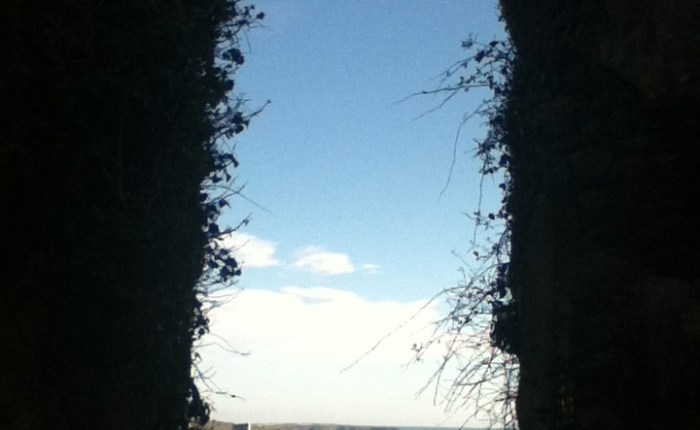
There is a window.
A window with no glass.
A window framed by stone.
Rather, stones.
There is a window with no glass
and it is framed by stones.
It has a ledge
made from a piece of wood.
much like the stones,
this piece of wood
is a found object.
This window is made a window
by the piece of wood.
without this wood
this window is just a hole in a wall made out of stones.
This window comes to my mind now,
though this window is no more.
Nevertheless
this window left an opening in me
ever since the first and last time I saw it.

It was in the house,
the broken house
made of stones
next to the gate
we had to open
to get to the house
made of bricks.

There was a drive from the gate
to the house made of bricks.
A dirt road between two fields
with fences of stone.
on the right the cows;
on the left the veg.
We never stopped at the house made of stones,
only to open the gate.
Then the drive down
to the house made of brick.
where we met and shook hands
and had tea
and mashed spuds with milk and bit of boiled bacon
and the kitchen would steam
so we had to leave the side door open
even when it was cold
and the steam would pour out the door
and chickens in the yard
would cluck and ruffle and shuffle
and the cats would snooze
and the lads would strike the hurley
off the wall
in their Sunday best.

I was only in the little house made of stone the once.
Flew down to it on borrowed bicycles,
jarring and jangling down the dirt road
eating bugs as we soared with mouths open.
we left the bicycles
propped up against the fence
climbed over to the house made of stones.
There was no roof to speak of
and the inside was grown over with grass.
Crossing the threshold of the doorway,
we ducked
even though there was nothing above.
Only three walls fully standing,
mostly.
the stones had fallen
inwards and outwards
whichever way time had tossed them.
It was quiet in the house
even though we were still outdoors.
That is when I saw the window.
The window with no glass,
framed by stone with a piece of wood as a ledge.
And through the window I saw the road
and the gate
and the house made of bricks
and the cows and veg
and the steam.
And you said,
in hushed tones,
this is where we lived,
before the move to the brick house,
our family,
my family,
before.
We lived in the house by the gate
and we looked through the window
and opened the gate
for the others
who lived in the house made of bricks
before us.
This is where my family lived.
This is where we came to
once
to look out that window
in the house made of stones.

There is a window.
There is a window with no glass.
There is a window with no glass
and it is framed by stucco.
It has a ledge made of wood.
A fine piece of wood
smoothed and sanded
and finished by craftier hands.
This window is a window
because of this wood.
WIthout the wood,
it would be just a hole a wall made of stucco.
This window is inside my house
between the kitchen and the front room.
And sometimes
I rest my arms
on that finely crafted piece of wood
that serves as a ledge
in the window framed by stucco.
I rest my arms
and hold my head
and I think
about the window with no glass
framed by stones
and I wish
that I had gone there more
when I had had
the chance.

In the Round

The circle is a powerful thing
it holds and folds and centers
it comforts, confronts, and constructs
it is the building block
the wrecking ball
the crown upon itself.
It is the open table
and the closed loop
where all who join are connected to each
and the link binds us together.

It is the moon and the sun and the stars above
the earth beneath and the core within.
It is the beating heart and the glancing eye.
the agape mouth
and the clenched fist.

It is the receiving bowl and the giving basket.
It is the serpent’s head
meeting the serpent’s tail.
It is the very apple

It is the dancing girls in May
and the flowers weaved upon their tresses
It is the place where the cats curl up
and the boys chase after
and twisting
and twirling
we
all
fall
Into.