The Myths of Natural Phenomena

The Myths of Natural Phenomena

The second Saturday discussion and creative prompts centered around natural phenomena: earthquakes, mountain formations, typhoons, etc. Interesting highlights of that discussion were the similarities in tales across mythology and the almost universal need to tell stories of how it happens. Especially the scary stuff. We talked about how in myth, there is a warning to others, a protocol established in face of the immense – Nature, God, what you will.

After we shared our pieces, I asked each of my fellow writers to describe the community in which their pieces took place. They were able to describe in detail the location and kind of setting and people. It always amazes me how much a storyteller has within, that is never directly shared, but is visible to the hearer nonetheless. Because they see it, we see it.

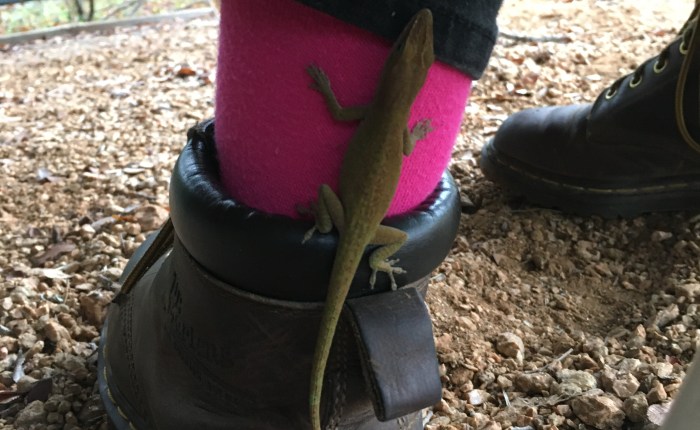
We also had a visitor join us for the final discussion. We think he was attracted to the warmth and color of those awesome pink socks! Anoles like stories too!

Okay, so here is my tale. Please, feel free to share your own in the comments and/or any thoughts you have to continue the discussion.

Zephy and Phyr, Daughters of the North Wind

The North Wind had two daughters and seven sons. He divided his wind duties amongst his sons, giving each of them dominion over each of the seas. His two daughters, the youngest two of his mighty brood, were not assigned any duties. Blustering, bellowing, and blowing were not lady like endeavors, after all.

For the second youngest, Zephy, this was just fine. She wore light colored dresses and walked lazily through the long grass picking up dandelions, letting them drift along with her. She would kiss the faces of the animals she walked by and rustle their fur, feathers, and hair.

Now, Phyr, the youngest, was not sated by this sedate lifestyle. She wore dresses, yes, but they were in grays, blues, and black. She had talents as wonderful as her brothers, and, in some cases, she far excelled their skills. She pleaded with her father to give her more meaningful responsibilities than wearing dresses and walking through fields and forests.

“You are a lady, Phyr.” The North Wind sighed, “There are protocols to follow. I know you’re gifted, and I am proud of you. But, there are rules and dresses are a must for girls.”

“But, I want to do more, and dresses are too restrictive!” Phyr pleaded.

“I’ll tell you what,” her Dad relented, “You may exercise your gifts however you wish, but you must remain in the forests and fields and in a dress.”

Phyr knew not to press her father further and demurred. She went out into the fields to join Zephy. She was not daunted though, and decided to find out what she was working with.

She began to sway right to left and her skirts flowed and filled with air. The grass around her began to bend lower to the ground, swaying with her. Phyr’s heart began to beat a little faster. She raised up arms, stretching them out away from her, and she began to twirl. Faster and faster she spun; she lifted off the ground and her hair streamed around her. She laughed and laughed, and spun and spun. When she slowed and lowered to the ground she laughed dizzily and bent down to regain her composure. Then she lifted up, Zephy was standing in front of her looking a little disheveled herself.

“Phyr! look what you’ve done!”

Looking back there was a line of destruction – pulled up roots, flowers, and grass. Animals stumbled to their feet and looked around dazed. Phyr looked around, still panting, and stared wide-eyed at her sister saying, “That was awesome!”
What to do to do to do?

What to do to do to do?

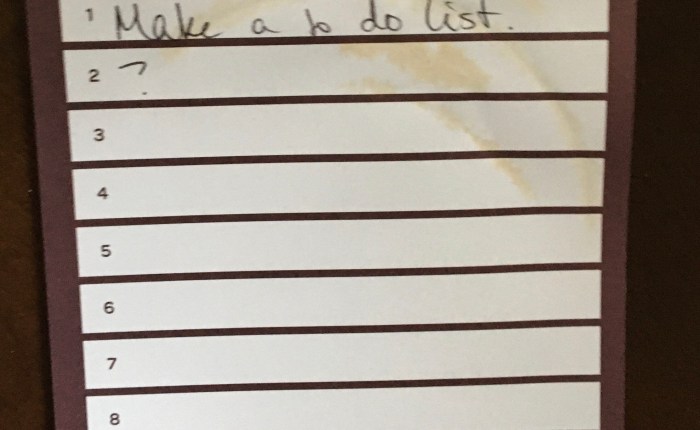
I was looking through my poetry folder today, and I came across this misfiled note. and then I thought- maybe not?

Things that need doing. Spring 2019 found again in Fall 2020

Taxes
Canceling the Y
Creating Job descriptions
Can C’s’ job include student behavior?
Printing emails
Talking to student – J, again.

Teacher & Admin reviews for next year
Get earplugs
Clear the clutter
Shut out the noise
Paperwork, paperwork, paperwork
Let the dog in.

Cinquain: A Form For Patience?

Cinquain: A Form For Patience?

How many times must I say this? How many times until you learn? How many times until you trust me? How many times is enough? How many? Ah, the frustration of repetition. I just said that! We have gone over this a million times. I have it figured out, why not you?
Funny, you would think I would have learned by now…
When I was finishing my PhD thesis, I submitted it for review by the department head. If he gave it the a-okay, it went to final submission and then to the Viva or oral defense. I had used my official name on the thesis, a name which very few people knew me as, including our department head. I don’t know if this would have altered some of the more abrasive comments about my lack of clarity or the missing elements, but I’d like to think so. I had been working on this thesis for 7 years and I had thought I was done. I was not. Once I picked myself up off the floor, and had a good cry at my Mum’s, I went back to my supervisor to see what was salvageable.
The main issue was that I had left out a discussion of an intrinsic foundational argument. The lead up to or history of the subject if you will. At first, I was affronted, of course I had laid that foundation. It was all there in black and white, what was he talking about?
Alas, sometimes when you sit with a subject for so long and you know the ins and outs of your thought process so intimately, you fail to see that not all of your ideas and meanings are self-evident to the rest of the world. Nor, for that matter, to your department head.
I’ll admit it hurt. Deeply and emotionally to read some of the remarks made in an off-handed, dismissive tone. My first chapter and beyond peppered with “she fails to see” and “has she even read…?”
What I had failed to see was that I had been unclear in my meaning. My foundation was rushed, so that I might dive into the meat of my argument, the areas that held my fascination and joie de vivre.
I rush. I am impatient. I miss steps. Sometimes in my rush to the good stuff, I leave out a few steps. And it ends up biting me in the tuchus.
Fast forward to my first year teaching – I told my students, “right. Over the weekend, you need to write a 2-5 page paper on the following topic…” I asked, “do you understand?” They nodded their heads, collected their stuff and went on their way. Monday arrived, I held out my hands for their papers and not one, not one student, turned it in. I was livid. “What on earth are you all thinking?!” “What is going on here?” A few brave souls put up their hands and said, “we didn’t know what to do! You didn’t even give us a handout!”
It’s true; I hadn’t. I wasn’t teaching college students anymore. I was teaching high school Sophomores, and they needed a lot more guidance than I had given them. I had failed to see, again. So, I set aside more time for paper prep and as the years passed that time grew and grew. Writing isn’t easy, especially in the beginning! Oh, and the middle, and the end….

I am learning to become less frustrated with repetition. To stop and make sure the foundation is solid before jumping into designing the attic lounge area. Which brings me to another form. A poetic form that works on a step-by-step process of poem making. It is short, sweet, and specific. A good form to practice a “one foot before the other” process.

A cinquain is a five line stanza. There are three separate forms that qualify as cinquains and each holds a specific purpose.

The first form centers around word count for each line. It may be written about anything. It’s used to describe a person, place, or thing.

Line1: One word
Line2: Two words
Line 3: Three words
Line 4: Four words
Line 5: One word

The second form is strictly about a specific noun, but not (usually) a specific person–in rare occasions, I have seen them about specific objects. For example, it may be about a cup, a specific trophy, a work of art, ect.

Line1: A noun
Line2: Two adjectives
Line 3: Three -”ing” words
Line 4: A phrase
Line 5: Another word for the noun

This third form of cinquain is most easily adapted to various subjects. Its focus is on syllables. Feel free to use it any way you like, just stick to the form.

Line1: Two syllables
Line2: Four syllables
Line 3: Six syllables
Line 4: Eight syllables
Line 5: Two syllables

Finally, here are my attempts at each form of the form:

1.
Love
Pure Joy
Quiet calm devotion
Compassionate true fellow-feeling
Empathy

2.
Stream
Strong, wide
Flowing, Freeing, floating.
It winds ever on –
River

3.
Thunder
Growling in clouds
Waking the sound sleeper
Forcing its way through the night’s sky
Silence

The Bop Form

My students don’t like change. It’s a little paradoxical at times, because with the same breath that they use to disparage the “we’re always doing the same stuff in here” they will say, “hey! We forgot to do the meditation at the beginning of class!” They do like routine, but they also want things new and exciting. It’s a conundrum. Though, perhaps I am being unfair. After all, aren’t we all like that?

In my Interpersonal Studies class, we learn about these mice. The mice are being tested by two different labs to examine how animals engage and explore new and somewhat scary circumstances. For the mice, it is a platform that eventually loses its walls and is just hanging above the ground with no protection. In one lab the mice are cautious, at first, but then bound up and down the new “maze” with little to no hesitation. But, in the other lab, the mice a skittish and do not venture too far from the safety of the walls if at all. At first, the scientists are stumped. These mice are from the same batch, they are fed at the same time, kept in the same laboratory conditions, etc. There is only one slight difference. In one lab, the lab assistant is allergic to mice. So they have gloves on, a mask, and handle the mice only when absolutely necessary. In the other lab, the mice are, to put it non-scientifically, much loved. They are petted and held in ungloved hands and handled for longer periods of time. Can you guess which mice were the more furtive?

What I find additionally interesting here, is that all the mice want to go down that unprotected platform, but the “untouched” mice just don’t have the courage. They don’t feel safe. Which again, seems to bring a paradox into existence – if I don’t feel safe, then I’m not going to try something dangerous. Maybe it’s the idea that you need an anchor to try something new. I will venture down this unprotected path because I trust that my protected path will be there when I get back.

We do all want new and exciting, but we also want that “secure base” that Goleman speaks of.[1] That familiar comforting place we can return to after the thrill of the new.
So it all comes down to building that base in my classroom. Which starts with building trust. Showing students that change is going to happen in life, but that doesn’t always have to be a bad thing. That they can try new things, and fail at new things, and that is just fine as long as they continue to try.

So, with that in mind, today I attempt The Bop Form. It is a relatively new form. It is, according to poets.org, a form of poetic argument. It is three stanzas long: 6 lines – 8 lines – 6 lines. The first stanza states the problem, and the second stanza explores or expands upon the problem. If there is a resolution to the problem, the third stanza finds it. If a substantive resolution cannot be made, then this final stanza documents the attempt and failure to succeed. I combined this form with another exercise I use with my students which is the personified abstract noun exercise. This has resulted in some breathtaking descriptions of such things as depression, anxiety, joy, and love from my students.[2] But I thought I would attempt it with the concept of change. Here it goes:

Change comes in like she owns the place
Ordering and reordering
She may ask your opinion,
But does she really listen?
I’m not so sure.
But, I still hope she does.

You see, Change is the boss.
She is the one making all the calls
You can run along beside
And try and keep up
Or you can stay back in the dust.
She doesn’t mind either way
What’s gonna happen is gonna happen.
And that is something you can’t change.

One thing you can do,
When it comes to change,
Is learn to accept her.
Things will go much smoother for you.
Because if you fight her?
I got news, you’re gonna lose.

[1] This phrase and the mice example come from the text we use in my class: Social Intelligence, by Daniel Goleman. [2] This exercise comes from Old Faithful: 18 Writers Present Their Favorite Writing Assignments.

Your Turn!

Stanzas: 3
Lines: 6 – 8 – 6
Breakdown: 1st – Problem; 2nd – Exploration of Problem; 3rd – Solved or Unsolved?


Limerick Form

Today was graduation.  The Class of 2016 has walked across the stage and moved their tassels to the left. I would say that most of the family celebrations are now coming to an end, and the students have moved on to celebrating with their classmates at various house parties. But, I don’t know that for sure.  What I do know for sure is that I am incredibly proud of each and every one of those human beings, and I wish nothing but the best for them.

It was an interesting day for me.  This was my first class of Sophomores who graduated today.  My first group of high school students I had ever taught.  The growth from that 2nd year of school to the 4th is quite extraordinary.  Not alone do teenagers change dramatically in their looks, their level of maturity in their thoughts and actions also develop at what seems an exponential rate.

I remember these students surprising me on their return from Christmas break that first year I had them.  They seemed to have aged years in a span of two weeks.  They were taller, faces altered, their voices deeper, and their attention spans just a little more focused.  I could not fully grasp what I had experienced, but it felt amazing.  Being witness to the growth of a human being is such a gift.  Even for a few years.

In fact, it is all a little absurd.  Which is why I have chosen the humble limerick for this week’s form.  An absurd poem for an absurd moment. When reading up on the limerick it has been equated to both a “madsong” and a “nonsense verse.”  The OED tells me that it is “intended to amuse by absurdity.” The limerick is traditionally a bawdy little rhyme, but it doesn’t have to be.  They are often spoken to make people laugh though.  It has five lines with an aabba rhyme scheme.  With the three “a” lines usually longer than the two “b”‘s.

So here is my try then.  I have to admit that I am not in a particularly bawdy nor humorous mood this evening.  I am, like many of my colleagues, absolutely exhausted and a little saddened to have a year finished.  And at the same time so very happy to have a year finished.  Life is fun, no?  Goodnight then, and I hope you enjoy a rather more pensive limerick than one might have expected…


The school is so quiet at night time
The bells echo loudly as they chime.
It’s like an intrusion,
A mental confusion.
A dark, empty school is quite sublime.


Your Turn!

Lines: Five
Rhyme: aabba
Rhythm: “a” lines 9 syllables, “b” lines 6 syllables